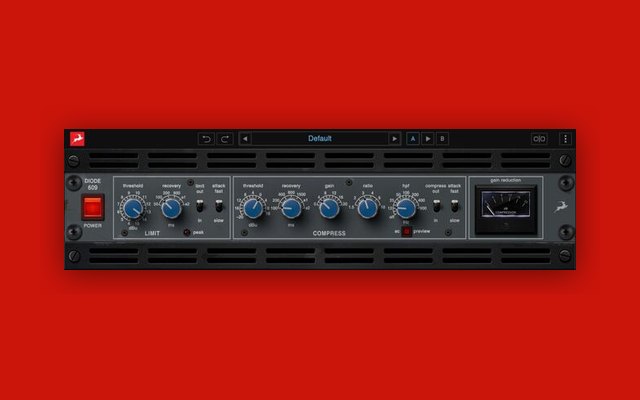
About Diode 609
Diode 609 takes its name from a circuit topology rather than a product line, and the catalogue should establish which hardware it models before publishing, since the "609" designation plus the diode reference points at a specific lineage of British compressors whose behaviour depends entirely on which model was copied.
The circuit family explains why these compressors sound as they do. The defining element is a diode bridge — four diodes arranged so that a control voltage varies their conduction, attenuating the audio passing through — and three consequences follow. The threshold is soft and the knee is broad, so compression arrives gradually rather than at a defined point, which is why these compressors are described as smooth rather than aggressive. The gain element introduces distortion of its own, since the diodes are non-linear devices sitting directly in the signal path, which gives the compressor a colour even when it is not compressing — and that colour is the reason the circuit is emulated at all, rather than its gain control alone. And the attack and release are not fast — the control voltage has to charge a capacitor through the diodes, which makes the timing inherently program-dependent, and is why these units are chosen for bus and mix compression rather than for taming transients. The practical consequence for a buyer is that a diode compressor is a glue and colour device rather than a control device, which is a different job from a FET compressor's fast transient handling or an optical compressor's program-dependent sustain, and the catalogue should state which role a given product is designed for. The developers in this range approach diode compressors in documented ways worth carrying. Lindell Audio's 80 Series is an exacting emulation of classic vintage preamp/EQs, a diode bridge limiter/compressor, and a legendary line amplifier module, where the diode bridge component corresponds to the Neve 2254 limiter/compressor drawn from the hand-wired 8028 desk, supplied as individual modules, a channel strip variant and a Buss version — so a buyer can use the compressor alone or as part of a strip. And the SPL Iron is a variable bias tube compressor with a parallel dual tube circuit combining two tube types, custom Mu-Metal Iron Transformers, a feed-forward resistive Vactrol-Opto-Isolator, and six different rectifier settings available, which is a different topology from a diode bridge but appears in the same product tier — so the catalogue should state the circuit rather than the price band, since two compressors at the same price can be entirely different devices. TMT applies across the Plugin Alliance and Brainworx range as Brainworx patent-registered Tolerance Modeling Technology, US Patent No. 10,725,727, which simulates channel-to-channel variances in electronic components, and its effect of producing slightly different instances is what gives a modelled product width that identical instances do not. The catalogue should verify whether M/S processing is included, since the current generation of this product tier commonly adds it — as on the SPL Iron, where additional digital-only features include a monomaker, stereo width control and MS processing.
Suits mix bus and drum bus compression, and track processing where colour is wanted alongside control.
#Diode609 #DiodeBridge #DiodeCompressor #BusCompressor #GlueCompressor #SoftKnee #ProgramDependent #NonLinear #Colour #Neve2254 #LindellAudio #80Series #Brainworx #PluginAlliance #TMT #SPLIron #MuMetal #M/SProcessing #MonoMaker #Mixing #Mastering #MusicProduction #VST #VST3 #AU #AAX
Rate & Recommend
Your Rating
Would you recommend this plugin?
Diode 609
A diode-based compressor emulation — confirm the specific hardware modelled before publishing.
Platforms
Formats
0
Downloads
3
Views
0
Recommends